

Deepfakes, Photo Substitution and Document Fraud: What Your KYC Stack Needs to Catch
Identity fraud has moved on. The old playbook of a blurry photocopy and a hopeful smile is being replaced by AI-generated faces, cloned selfies and cleanly edited ID cards. If your verification flow was designed to catch a lazy human, it will not catch a motivated one with modern tooling.
This post breaks down three attack categories — deepfakes, photo substitution and document forgery — and the controls that actually address each one.
Three attacks, three failure modes
It helps to separate these threats because they exploit different weaknesses in a verification flow.
Deepfakes
A deepfake is a synthetic or manipulated face used during the biometric step. It might be a video played back to a camera, a face swapped onto a real person in real time, or an AI-rendered face that never existed. The goal is to pass face match and liveness checks without a real human being present.
Deepfakes attack the biometric layer. A system that only compares a submitted selfie to the document photo — without confirming the selfie came from a live person — is wide open here.
Photo substitution
Photo substitution swaps the portrait on an otherwise genuine document, or pairs a real document with a selfie that belongs to someone else. The document may be authentic; the face is the lie.
This attack sits at the boundary between document checks and biometrics. Document authentication alone may pass the ID. Biometric matching alone may pass a well-matched pair of fraudulent images. You need both, cross-referenced.
Document forgery
Here the document itself is fake or altered: edited data fields, cloned templates, printed-and-laminated cards, or tampered security features. The fraud lives in the pixels and structure of the document image.
Heads up
Treating these as one problem leads to one-dimensional defenses. A liveness check does nothing against a forged passport, and document authentication does nothing against a deepfaked selfie. Coverage requires layers that map to each attack.
Layer one: document authentication and OCR
Start with the document, because a real face on a fake ID is still fraud.
- OCR and data extraction read the visual zone, then cross-check it against machine-readable data.
- MRZ and barcode reading let you validate the check digits and confirm the encoded data matches what is printed on the front.
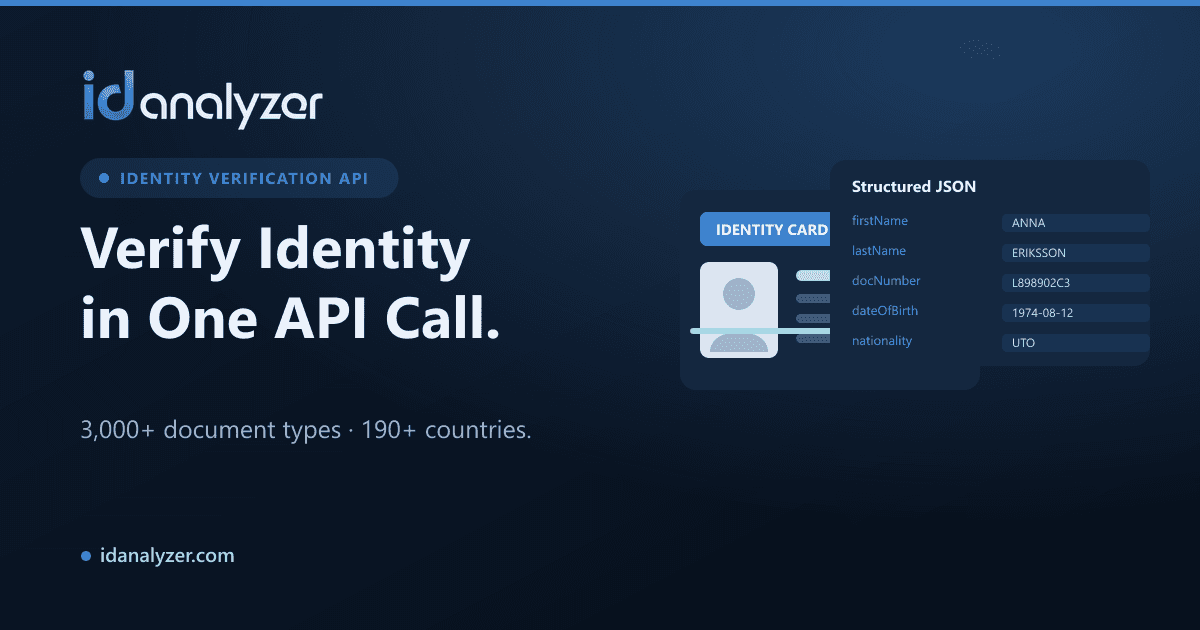
- Document authentication inspects security features, layout consistency, fonts and known template characteristics across 3,000+ document formats from 190+ countries.
- Anti-forgery checks flag signs of tampering, screen recapture and digital manipulation.
When printed data, the MRZ and the barcode disagree, that inconsistency is often the first signal of a substituted photo or edited field. These cross-checks are cheap to run and catch a large share of low-effort fraud before it reaches the biometric step.
Layer two: biometric face match
Once you trust the document, confirm the person presenting it is the person on it.
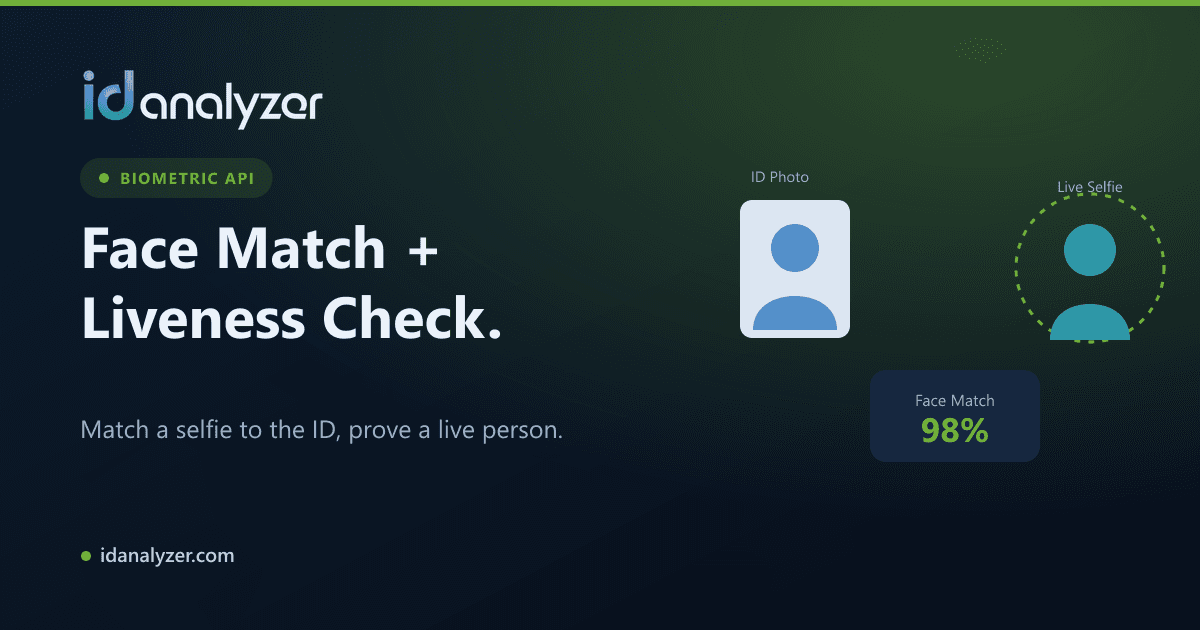
Biometric face match compares the live capture to the document portrait and returns a similarity score. This directly targets photo substitution: even a flawless document fails when the face does not match its holder.
The key is what you feed into the match. A static uploaded selfie can be a stolen photo or a rendered face. That is why match should never stand alone.
Layer three: liveness detection
Liveness is the control designed for the deepfake era. It answers a different question than face match: not "is this the right face?" but "is this a real, present human?"
Liveness detection looks for the signals of a genuine live capture versus a photo, a video replay, a mask or an injected synthetic feed. Combined with face match, it forms the pair that closes the gap:
- Liveness rejects the deepfake or replay.
- Face match rejects the wrong person.
Neither alone is sufficient. Deepfake attacks are specifically engineered to satisfy a naive match, so the liveness layer carries the weight of separating real presentations from synthetic ones.
Putting the layers together
The strongest flows chain these checks so each one guards a different attack surface:
- Capture the document and run OCR + MRZ/barcode extraction.
- Cross-validate printed data against the machine-readable zones.
- Run document authentication and anti-forgery analysis.
- Capture a live selfie under liveness conditions.
- Run biometric face match between the live capture and the document portrait.
Only when every layer passes should the identity be accepted. A failure at any stage should route to review rather than silent approval.
Note
For higher-risk onboarding, extend the flow with AML, PEP and sanctions screening once identity is confirmed — the same person may be genuine but still require enhanced due diligence.
Practical notes for developers and compliance teams
- Log intermediate signals. Store scores for document authenticity, face match and liveness separately. Aggregate pass/fail hides which layer is being probed.
- Tune thresholds by risk. A low-value account and a large transfer should not share the same bar.
- Watch for injection. Fraud increasingly bypasses the camera and injects a prepared feed. Prefer capture paths you control over uploaded media where possible.
- Keep data controlled. If residency or privacy requirements are strict, on-premise deployment through ID Fort keeps processing inside your own environment while retaining the same layered checks. ISO 27001 practices apply across the platform.
Deepfakes, photo substitution and forgery are distinct problems that share one weakness in weak systems: a single point of trust. Spread that trust across document authentication, face match and liveness, and each attack has to defeat every layer at once — a far harder task than fooling any one of them.