

Reading PDF417 Barcodes on North American Driver Licenses
Flip over almost any driver license issued in the United States or Canada and you will find a dense, rectangular barcode on the back. That is a PDF417 symbol, and it carries a structured copy of the cardholder's data. For KYC and age-verification workflows, this barcode is one of the most useful and most reliable data sources on the entire document.
This post explains what PDF417 is, how the data is structured, why it matters for verification, and the practical pitfalls developers hit when they try to parse it.
What PDF417 actually is
PDF417 is a stacked, two-dimensional barcode format. Unlike a QR code, it is wider than it is tall and is made up of multiple rows of bar-and-space patterns. The "417" refers to the structure of each codeword: 4 bars and 4 spaces spanning 17 modules.
The important thing for verification is that PDF417 holds far more data than a 1D barcode. On a North American license it stores a text record describing the cardholder, mirroring much of what is printed on the front.
The AAMVA standard
The contents of the barcode are governed by the AAMVA (American Association of Motor Vehicle Administrators) DL/ID Card Design Standard. Most US states and Canadian provinces follow it, which is why the same parser can read licenses from many jurisdictions.
The data is organized into named subfiles and element IDs. Each element uses a short code, for example:
DAC— first nameDCS— last nameDBB— date of birthDBA— license expiration dateDAG— street addressDAQ— license/ID numberDCG— country
The header also includes the AAMVA version number, the issuing jurisdiction (IIN), and the number of subfiles. Different jurisdictions may include optional elements, so a robust parser reads what is present rather than assuming a fixed layout.
Why the barcode matters for verification
The printed front of a license is designed for humans. The PDF417 barcode is designed for machines, and that gives it several advantages.
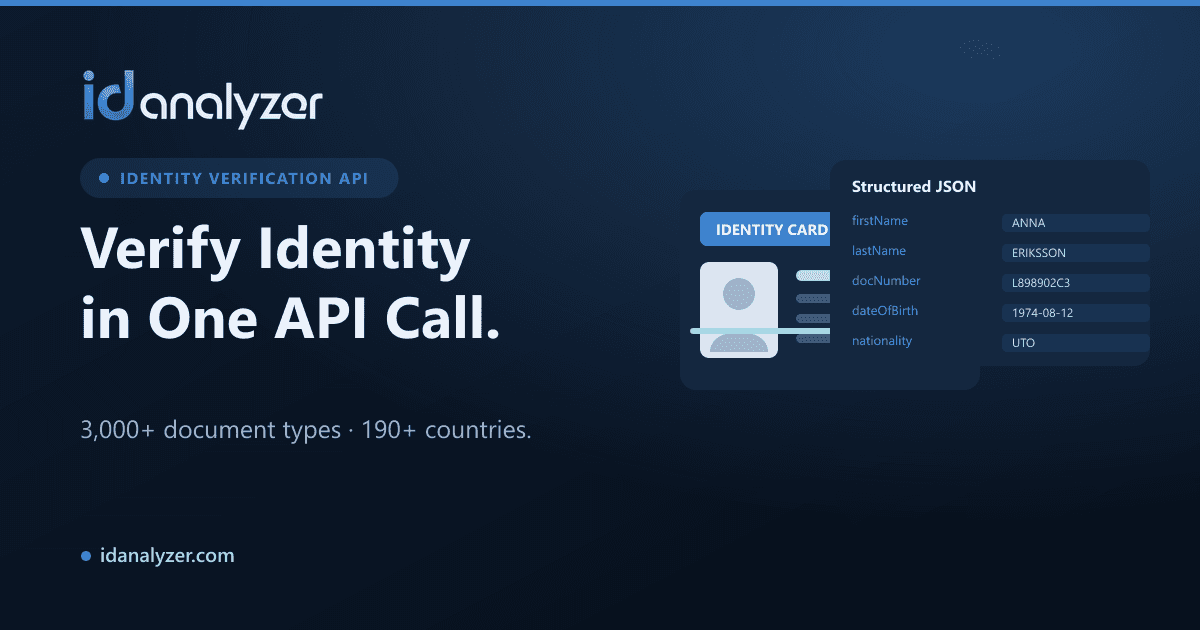
Structured fields. You get name, date of birth, address, document number, and expiration as discrete fields, without the ambiguity of parsing free-form printed text.
Cross-checking. Because the same information appears on the front and inside the barcode, you can compare the two. If the OCR-read date of birth on the front does not match the DBB value in the barcode, that is a strong fraud signal. Tampered or reprinted cards frequently fail this consistency check.
Age verification. For retail, gaming, and regulated sales, the barcode DBB field gives a clean, parseable birth date that is hard to fudge.
Note
The PDF417 barcode and the human-readable front are two independent representations of the same identity. Comparing them is one of the simplest and most effective tamper checks you can run.
Common pitfalls when parsing PDF417
Even though AAMVA defines a standard, real-world licenses introduce plenty of edge cases.
Version drift
The AAMVA standard has gone through multiple revisions. Older cards still in circulation use earlier versions with slightly different element sets and header formats. Your parser must branch on the version number in the header rather than assuming the latest spec.
Truncated and padded fields
Some jurisdictions pad fixed-length fields or truncate long names. Names that exceed the field length may be cut off, so the barcode value can differ slightly from the printed full name. Treat exact-string matching with caution and normalize before comparing.
Non-standard and legacy formats
A handful of jurisdictions, and many older cards, deviate from the standard or use vendor-specific encodings. Robust handling means reading what you can and flagging the rest, not throwing an error.
Image quality
Worn, scratched, or low-resolution scans degrade barcode readability. PDF417 has error correction built in, but a heavily damaged symbol may be unreadable. Capturing the back of the card at adequate resolution and lighting matters as much as the parser.
How ID Analyzer handles it
ID Analyzer reads the PDF417 barcode as part of document processing, alongside OCR of the printed front and MRZ parsing on documents that carry one. The platform decodes the AAMVA fields, normalizes them, and exposes them as structured data you can consume directly.
Because the barcode and the printed front are both extracted, the system can compare them automatically and surface mismatches as part of its fraud and authenticity checks. Combined with document authentication, this gives you more than a raw data dump — it gives you signals about whether the card is genuine.
The same pipeline supports more than 3,000 document formats across 190+ countries, so North American licenses are handled within a broader verification flow rather than as a one-off integration.
Practical recommendations
If you are building barcode-based verification into your own flow, a few guidelines apply regardless of vendor:
- Always capture the back of the card. The barcode is only on the back, and skipping it means losing your best structured data source.
- Cross-check front and back. Treat any mismatch between OCR and barcode fields as a risk signal worth reviewing.
- Do not rely on the barcode alone. A barcode can be copied onto a counterfeit. Pair it with document authentication and, where appropriate, biometric face match and liveness.
- Plan for version differences. Build or choose a parser that handles multiple AAMVA versions gracefully.
PDF417 is a quietly powerful tool. Read it correctly, validate it against the rest of the document, and it becomes a dependable foundation for fast, accurate identity checks across North America.