

Deepfakes, Photo Substitution and Document Fraud: What KYC Teams Need to Know
Identity fraud has moved on from glued-on photos and crude photocopies. Today a fraudster can generate a synthetic face, animate it to pass a video check, or quietly swap the portrait on an otherwise genuine document. For developers and compliance teams, the challenge is no longer spotting one obvious fake — it is detecting several different attack types at once, each targeting a different layer of your verification flow.
This post breaks down three of the most common attacks and the controls that actually counter them.
Three attacks, three weak points
Document fraud
Document fraud targets the ID itself. It ranges from fully counterfeit documents to subtle alterations of genuine ones: edited dates of birth, modified MRZ digits, or tampered security features. Because many of these documents look correct at a glance, manual review alone is unreliable.
Automated document authentication examines features that are hard to reproduce — font consistency, layout precision, the relationship between the printed data and the machine-readable zone, and known security elements for each document type. When the MRZ or barcode is cross-checked against the visual data and the two disagree, that mismatch is a strong fraud signal.
Photo substitution
Photo substitution is one of the oldest tricks, but it remains effective because the rest of the document can be genuine. A fraudster takes a real ID and replaces the portrait with their own — or with someone else's — so the document passes a casual data check while belonging to a different person.
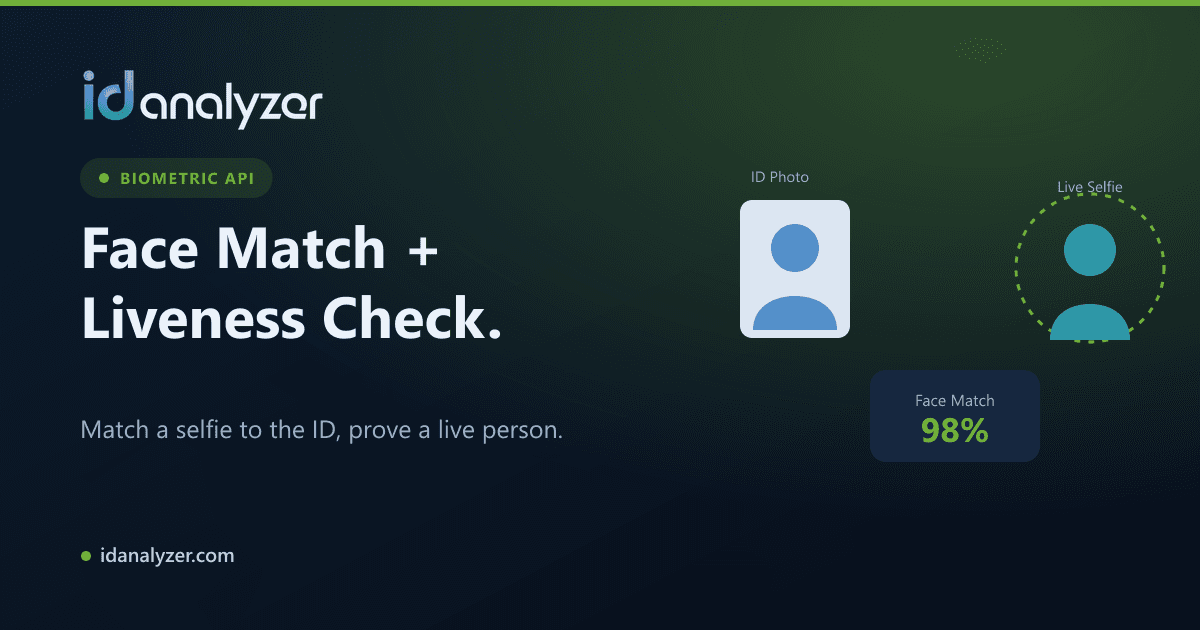
Detecting substitution requires looking beyond the data fields. Anti-forgery checks can flag inconsistencies around the portrait region, while a biometric face match between the document photo and a live selfie confirms whether the person presenting the ID is the person it actually belongs to.
Deepfakes
Deepfakes attack the biometric step directly. Instead of altering a document, the fraudster presents a synthetic or manipulated face to the camera — a generated image, a replayed video, or a real-time face swap — hoping to defeat the selfie or liveness check.
This is where liveness detection matters most. A static face match alone can be fooled by a high-quality image. Liveness verifies that a real, present human is in front of the camera, raising the bar against printed photos, screen replays and synthetic video injection.
Heads up
No single check stops every attack. A fraudster who can defeat your face match may not be able to forge the MRZ, and one who can forge a document may fail liveness. Layering controls is what closes the gaps.
Why layering beats any single check
Each attack type exploits a different assumption:
- Document fraud assumes you only inspect the data, not the security features.
- Photo substitution assumes you never compare the document photo to the live user.
- Deepfakes assume your biometric step cannot tell a real face from a fake one.
A verification flow that combines document OCR, document authentication, biometric face match and liveness forces an attacker to defeat all of them simultaneously — a far harder task than beating any one in isolation.
A practical verification sequence
- Capture and read the document. Use OCR to extract the data fields and read the MRZ or barcode. Cross-check the two for internal consistency.
- Authenticate the document. Run anti-forgery and security-feature checks against the expected template for that document type and issuing country.
- Match the faces. Compare the document portrait against a live selfie to confirm the holder.
- Confirm liveness. Verify the selfie comes from a present, live person — not a photo, replay or deepfake.
- Screen the identity. Run AML, PEP and criminal-records screening on the verified name to satisfy compliance obligations.
Running these steps together means a substituted photo fails the face match, a forged document fails authentication, and a deepfake fails liveness — even when the other steps would have passed.
Coverage and operational considerations
Fraud is global, and your verification needs to match the documents your users actually present. Support for 3,000+ document formats across 190+ countries reduces the blind spots where unfamiliar IDs slip through unchecked. A document type your system does not recognize is a document type you cannot authenticate.
For regulated and data-sensitive environments, deployment model matters as much as detection. Some teams cannot send identity data to external servers at all. On-premise deployment with ID Fort lets you run the same OCR, authentication and biometric checks inside your own infrastructure, while ISO 27001 practices and secure storage options like Vault support data-protection requirements.
Building defenses that age well
Generative tools will keep improving, so treat verification as a moving target rather than a one-time integration:
- Don't rely on a single signal. A passing face match is not proof of a genuine document, and vice versa.
- Log and review the signals you collect. Mismatches between MRZ and printed data, or weak liveness results, are useful even when an attempt is ultimately rejected.
- Tune thresholds to your risk. Higher-risk onboarding can demand stronger liveness and stricter authentication; lower-risk actions can stay lighter.
- Keep coverage current. Broad document support and ongoing updates matter as new formats and forgery techniques appear.
The fraudsters using deepfakes and photo substitution are betting that your verification checks one thing. The most reliable answer is to check several — document, data, face and liveness — so that defeating one control still leaves an attacker exposed by the others.