

Deepfakes, Photo Substitution and Document Fraud: What KYC Teams Need to Know
Identity fraud has shifted from crude, obvious forgeries to attacks that are increasingly hard to catch by eye. Deepfakes and photo substitution now sit alongside classic document tampering as the three fraud vectors every KYC team should plan for. This post explains how each works and where automated verification can stop them.
Three attack types, one goal
The goal of an attacker is always the same: pass identity verification as someone they are not, or as a person who does not exist. What differs is the method.
Document fraud
Document fraud targets the ID itself. It ranges from full counterfeits printed from scratch to alterations of a genuine document — a swapped photo, edited date of birth, or a modified name. Because a fraudulent document may look convincing under casual inspection, the defence has to go deeper than "does this look like a passport."
Photo substitution
Photo substitution is a specific and common form of document fraud. A genuine document is physically or digitally altered so the portrait is replaced with the fraudster's face. The layout, fonts and security features may all be intact — only the photo has changed. This is dangerous precisely because everything else about the document checks out.
Deepfakes
Deepfakes attack the biometric step rather than the document. Instead of showing their real face to the camera, an attacker injects or presents synthetic video: a generated face, a face-swapped stream, or a manipulated selfie designed to match the photo on a stolen document. The aim is to defeat the face match and liveness stage.
Why a single check is never enough
Each attack type exploits a gap that a single verification step leaves open.
- A document-only check can be beaten by a deepfake selfie that matches a stolen ID.
- A biometric-only check can be beaten by a real face paired with a counterfeit document.
- A photo-substituted document can pass a naive face match, because the portrait on the document is the fraudster.
The practical answer is layering. When document authentication, biometric face match and liveness run together, an attacker has to defeat all three simultaneously — a far higher bar than beating any one in isolation.
Heads up
Photo substitution specifically breaks the assumption that "the face matches the document, so the person is legitimate." If the portrait was swapped, matching the selfie to it proves nothing. Document authentication has to run alongside the face match, not instead of it.
How automated verification defends each vector
Detecting document tampering and substitution
Document authentication looks past the printed content to the structural and security properties of the ID. This includes checking fonts, layout consistency, security features, and signs of digital or physical manipulation. MRZ and barcode reading add a cross-check: the machine-readable zone on a passport or the barcode on a driver's license encodes the same personal data printed on the front. If a fraudster edits the visible name or date of birth but leaves the MRZ untouched, the mismatch is a clear signal of alteration.
For photo substitution, anti-forgery analysis can surface inconsistencies introduced when a portrait is replaced — irregularities that are hard to reproduce cleanly on a genuine document stock.
Catching deepfakes at the biometric step
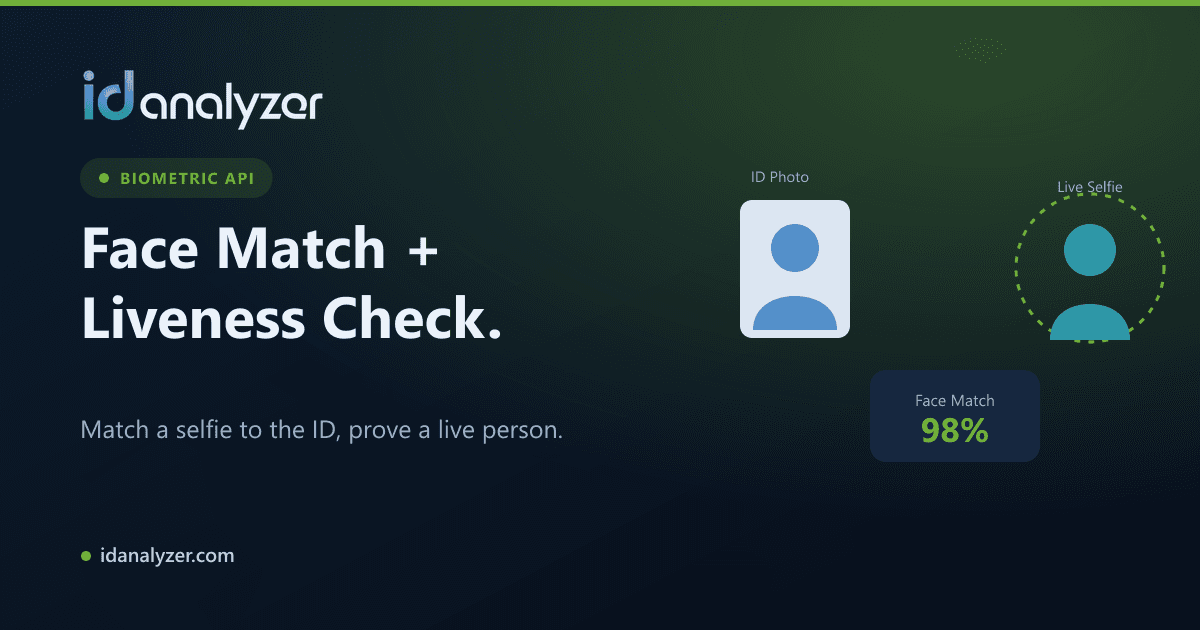
The biometric layer is where deepfakes are stopped. A face match compares the live capture against the document portrait to confirm they are the same person. Liveness detection then confirms the face in front of the camera belongs to a real, present human rather than a photo, screen replay, mask or synthetic video.
Liveness is the direct counter to deepfake and presentation attacks. A generated face that looks perfect in a still frame still has to survive checks designed to confirm a genuine live subject is present.
Screening beyond the document
Confirming a document is genuine and the person is real does not tell you whether that person carries risk. AML, PEP and criminal-record screening adds a compliance layer on top of identity, checking verified identities against sanctions, politically exposed persons and watchlists.
Building a layered flow
A resilient verification flow generally follows this sequence:
1. Capture and read the document
Use document OCR to extract the data and MRZ/barcode reading to cross-check machine-readable fields against the printed text. ID Analyzer supports 3,000+ document formats across 190+ countries, so the same flow handles global users.
2. Authenticate the document
Run document authentication and anti-forgery checks to catch counterfeits, tampering and photo substitution before trusting the portrait.
3. Match and confirm liveness
Compare the live selfie to the authenticated document portrait, and require a passive or active liveness check to defeat deepfakes and replays.
4. Screen for risk
Run AML, PEP and criminal-record screening against the verified identity where your regulatory obligations require it.
Deployment and data considerations
Where verification runs matters as much as how it runs. For teams with strict data-residency or regulatory requirements, on-premise deployment through ID Fort keeps document images and biometric data inside your own environment. ID Analyzer is ISO 27001 certified, and sensitive results can be stored in Vault when you need to retain verification records securely.
Key takeaways
Deepfakes, photo substitution and document fraud attack different points in the verification journey, so no single check covers all three. Pairing document authentication with biometric face match and liveness closes the gaps each attack relies on, and adding AML/PEP screening turns identity confirmation into a complete risk decision. Design your flow so an attacker must defeat every layer at once — that is what makes fraud economically unattractive.