

Liveness Detection vs. Anti-Spoofing: What Is the Difference?
If you have shopped for a biometric verification vendor, you have probably seen "liveness detection" and "anti-spoofing" used almost interchangeably. They are related, but they are not the same thing. Treating them as synonyms leads to gaps in your fraud model and awkward conversations with auditors.
This post clears up the terminology and shows how the two concepts fit together in a real onboarding flow.
Start With the Threat
Both terms exist to answer one question: is the face in front of the camera a real, present human, or an attack?
Attackers do not need to steal a genuine identity to break a weak face-match system. They can present something that looks like a face to the camera:
- A printed photo held up to the lens
- A photo or video replayed on a phone or monitor
- A cut-out mask or paper eyehole cutout
- A silicone or 3D-printed mask
- An injected video stream that bypasses the camera entirely (a deepfake or a virtual camera)
These are collectively called presentation attacks (and, for the injection case, injection attacks). The whole point of liveness and anti-spoofing is to stop them.
What Anti-Spoofing Means
Anti-spoofing is the goal. It is the umbrella capability of resisting any attempt to fool a biometric system with a fake or replayed artifact. In the formal ISO/IEC 30107 vocabulary, the equivalent term is Presentation Attack Detection (PAD).
Anti-spoofing is measured by how well a system rejects attacks. The relevant metrics come from PAD testing:
- APCER — the rate at which attack presentations are wrongly accepted as genuine
- BPCER — the rate at which genuine presentations are wrongly rejected
A strong anti-spoofing system keeps APCER low without pushing BPCER so high that real users get blocked.
What Liveness Detection Means
Liveness detection is a technique used to achieve anti-spoofing. It specifically checks for signs that the subject is a live human being present at capture time — depth, texture, micro-movements, reflections, blood-flow cues, and other properties that a flat photo or replayed screen struggles to reproduce.
Liveness detection generally comes in two forms:
Passive Liveness
The system analyses a single frame or a short capture without asking the user to do anything. It looks at texture, moiré patterns from screens, lighting consistency, and depth cues. It is fast and low-friction because the user just holds still for a selfie.
Active Liveness
The system prompts the user to perform an action — turn their head, blink, smile, or follow a moving target. The response is checked for natural, live behaviour. Active liveness adds friction but can be harder for a static artifact to satisfy.
Note
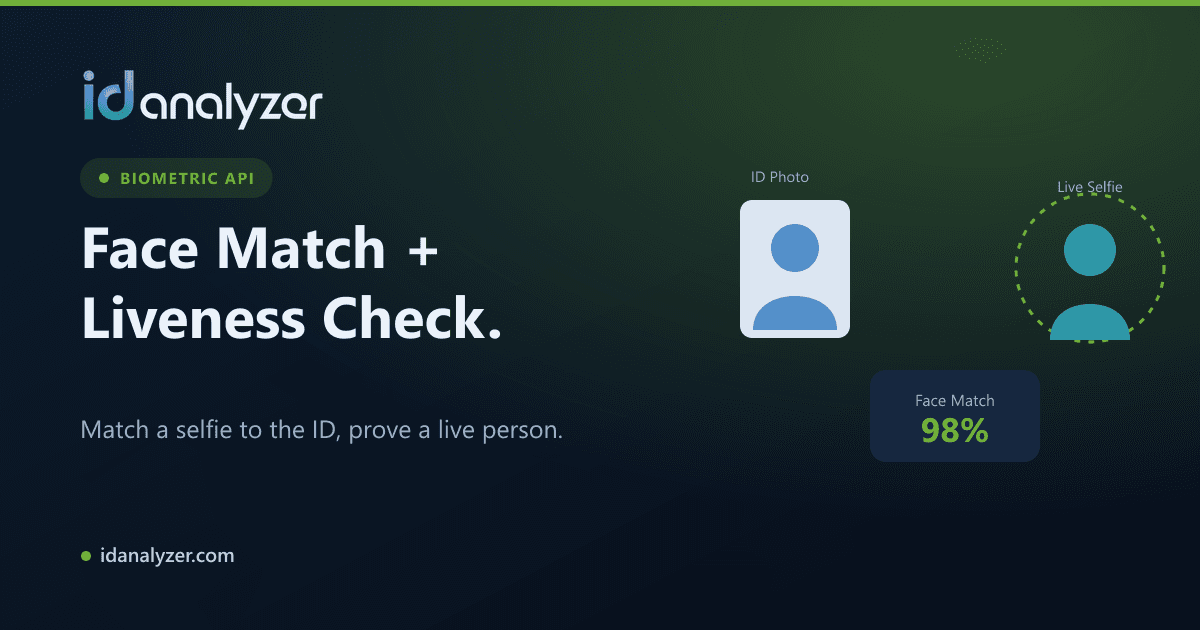
Liveness is not the same as face match. Liveness answers "is this a real, present person?" Face match answers "is this the same person as the ID?" A complete flow needs both.
So What Is the Difference?
Here is the cleanest way to hold it in your head:
- Anti-spoofing is the outcome — resisting all presentation and injection attacks.
- Liveness detection is one method that contributes to that outcome.
Liveness detection is the biggest and most common component of anti-spoofing, but not the only one. Anti-spoofing also includes things liveness alone does not cover, such as:
- Injection-attack detection — catching a spoof that never touches the physical camera, like a virtual-camera feed or a deepfake stream.
- Document anti-forgery on the ID side — detecting tampered or synthetic identity documents before you even reach the face-match step.
In other words, a vendor can do liveness and still miss injection attacks. A vendor can claim "anti-spoofing" and only mean passive liveness. Ask specifically which techniques are covered.
How It Fits an Identity Verification Flow
In a typical remote onboarding flow, the two concepts sit at different points:
- Document capture — read the ID with OCR and MRZ/barcode parsing, then run document authentication and anti-forgery checks.
- Selfie capture — run liveness detection to confirm a live, present human.
- Biometric face match — compare the live selfie against the portrait on the verified document.
Liveness sits in step 2. Anti-spoofing spans steps 1 through 3, because forgery detection on the document and injection detection on the camera feed are also part of resisting fraud.
ID Analyzer's Biometric API performs face match with liveness detection so you can confirm both who the person is and that they are really there.
Practical Guidance for Buyers
When you evaluate vendors, do not accept "we support liveness" as a full answer. Ask:
- Passive, active, or both? Passive lowers friction; active can add resistance for some attack types.
- Do you detect injection attacks? Camera-bypass and deepfake feeds are a growing threat that pure liveness does not always address.
- How is document fraud handled? A live human presenting a forged ID still needs to be caught upstream.
- What are your PAD metrics and standards alignment? Ask how APCER and BPCER are reported and under what testing conditions.
The Bottom Line
Liveness detection and anti-spoofing are not competing features to choose between. Anti-spoofing is the objective; liveness is a core technique for reaching it. A robust verification stack combines liveness with injection detection on the biometric side and anti-forgery on the document side.
Get the vocabulary right, and your fraud model — and your auditor conversations — get a lot easier.