

Deepfakes, Photo Substitution and Document Fraud: What Modern KYC Has to Defend Against
Identity fraud is no longer a matter of clumsy photocopies and cut-and-paste passport photos. Attackers now combine synthetic media with document tampering to defeat verification flows that were designed for a simpler era. If your onboarding still checks a document and a selfie in isolation, you are likely exposed to at least one of the attack classes below.
This post breaks down three overlapping threats — deepfakes, photo substitution and document fraud — and explains the verification layers that address each.
Three attack classes, one goal
The goal of every identity attacker is the same: convince your system that a document belongs to the person presenting it, when it does not. They get there in different ways.
Deepfakes
Deepfakes are synthetically generated or manipulated faces used to pass a biometric check. In a verification context they usually appear during the selfie or liveness step. An attacker may inject a pre-rendered video, drive a face-swap in real time, or replay a static image dressed up to look like a live capture.
The danger is that a deepfake can match a real, stolen document. The face on screen looks like the document holder because it was generated from their photos — so a naive face-match step returns a confident "yes."
Photo substitution
Photo substitution is the physical or digital replacement of the portrait on an identity document. A genuine document is taken, and the original photo is swapped for the fraudster's face. The document number, name and other data remain valid, which means basic data checks and even MRZ or barcode reads can pass cleanly.
Substitution attacks are dangerous precisely because so much of the document is authentic. Only the portrait — and the physical security features around it — reveal the manipulation.
Document fraud
Document fraud is the broadest category: forged documents, altered fields, expired templates, edited text, or entirely fabricated IDs. This includes digitally edited PDFs and screenshots as well as physical forgeries. Modern editing tools make font-matched text alterations trivial, so a document can look pristine while carrying manipulated data.
Why single-signal checks fail
Each attack targets a different assumption:
- A deepfake beats a system that trusts the selfie.
- Photo substitution beats a system that trusts the document photo.
- Document fraud beats a system that trusts the printed data.
Defeat one check and the others may never fire. Effective defense means layering independent signals so that passing one does not guarantee passing the rest.
Heads up
A face match alone is not proof of identity. If the document photo has been substituted, a genuine face match confirms the fraud rather than exposing it.
The verification layers that catch them
Document authentication and anti-forgery analysis
Before you trust any data on a document, you need to know the document is real. Document authentication inspects the template, layout, fonts, and security features to detect tampering, edited fields and known forgery patterns. This is the layer that catches text alterations and fabricated templates that OCR would otherwise read as legitimate.
Because identity documents vary enormously across jurisdictions, coverage matters. Support for 3,000+ document formats across 190+ countries means the authentication engine can compare a submitted ID against the expected characteristics of its real-world template rather than guessing.
OCR, MRZ and barcode cross-checks
Reading the visual zone with OCR and independently reading the MRZ or barcode gives you two data sources that should agree. When the printed name differs from the encoded MRZ, or a checksum fails, you have a strong signal of manipulation. Cross-field consistency is cheap to run and catches a large share of edited documents.
Biometric face match against the document
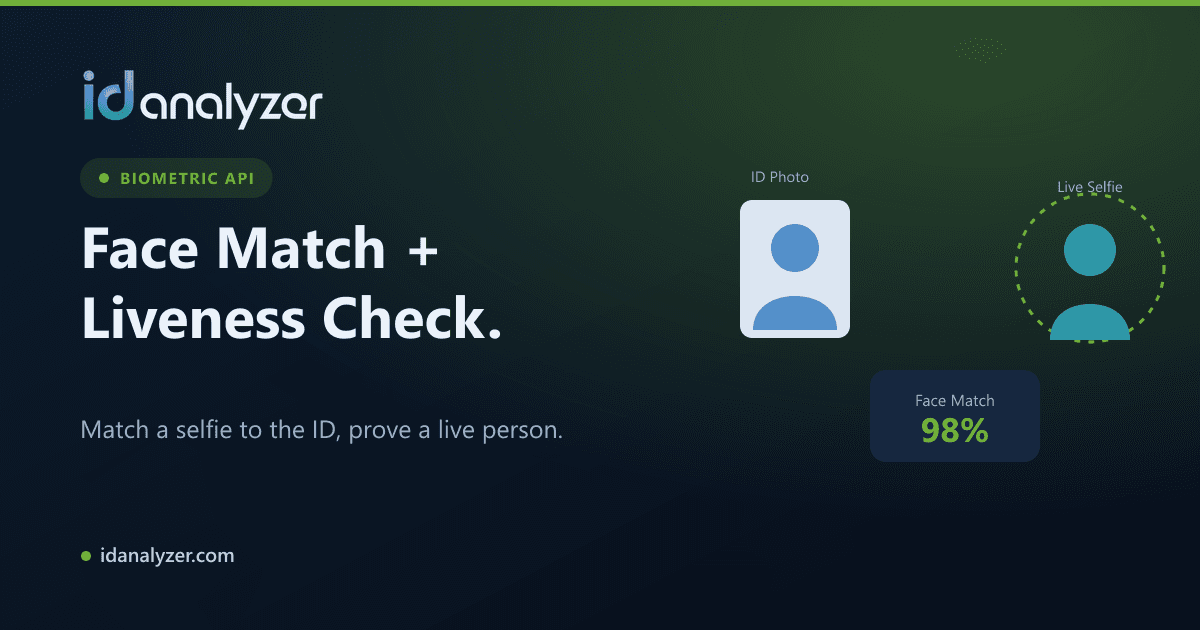
Face match connects the person to the document by comparing the live capture with the document portrait. On its own it is not enough — but combined with authentication that confirms the portrait has not been substituted, it becomes meaningful. The sequence matters: authenticate the document, confirm the photo is original, then match the face to it.
Liveness detection
Liveness is the primary defense against deepfakes and replay attacks. Rather than asking "does this face match?", liveness asks "is this a real, present human?" It targets injected video, screen replays and rendered faces that a static match would accept. Pairing liveness with face match closes the gap that deepfakes exploit.
AML, PEP and criminal-records screening
Once you trust the identity, screening tells you whether that person carries elevated risk. AML, PEP and criminal-records checks run against the verified identity, not the claimed one — which is why they belong after, not instead of, document and biometric verification.
Putting the layers together
A resilient flow chains these checks so no single bypass wins:
- Authenticate the document — detect forgery, substitution and edits.
- Read and cross-check data — OCR against MRZ and barcode.
- Match the face — live capture against the verified portrait.
- Confirm liveness — reject deepfakes and replays.
- Screen for risk — AML, PEP and criminal records.
Deployment and compliance considerations
Where verification runs matters as much as how it runs. Cloud APIs suit most teams, but organizations handling sensitive data or facing data-residency requirements may need to keep processing in-house. On-premise deployment through ID Fort keeps document and biometric data within your own environment, and ISO 27001 certification underpins the controls around it.
The takeaway
Deepfakes, photo substitution and document fraud attack different assumptions, so no single check defends against all three. The reliable answer is layered verification — document authentication, data cross-checks, face match, liveness and screening — arranged so that defeating one control is not enough to defeat the flow. Build for the combination, not the individual check, and the modern fraud toolkit has far fewer places to hide.