

NFC Chip Reading vs. OCR for Passports: What Every KYC Team Should Know
Passports are among the most trusted identity documents you can ask a user to present. But how you read a passport matters just as much as which one you accept. Two approaches dominate: OCR (optical character recognition) of the printed data, and NFC chip reading from the embedded electronic chip.
This post breaks down how each works, where they overlap, and how to combine them in a real verification flow.
What OCR actually reads
OCR extracts data from the visible surface of the passport — the same information a human border officer would read with their eyes.
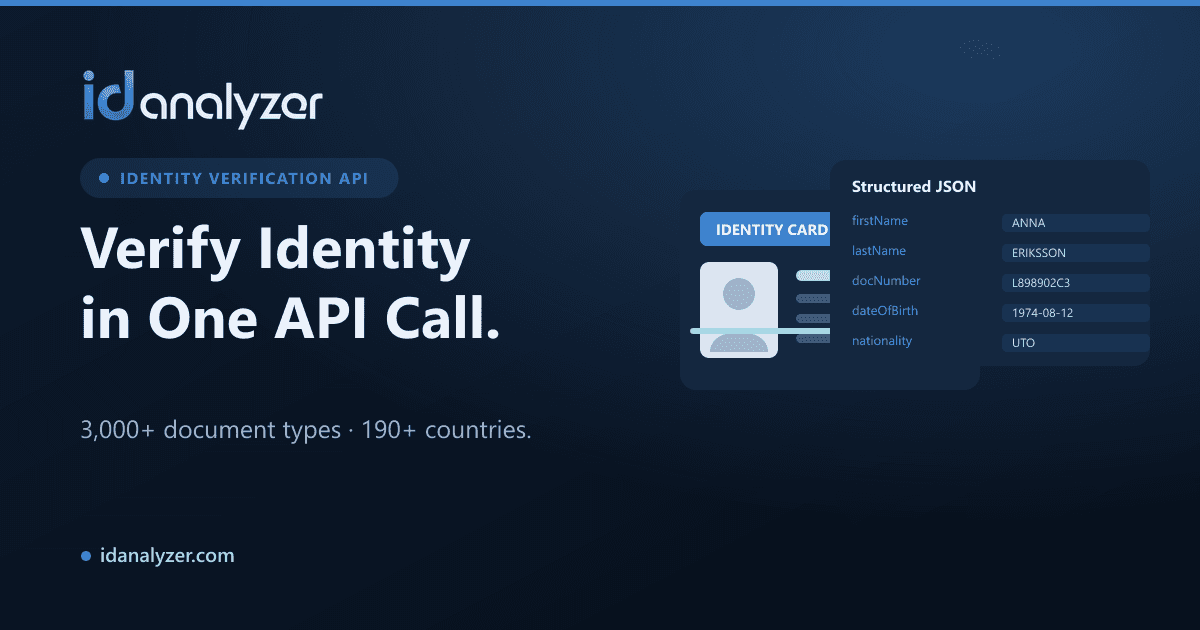
For passports, the most reliable target is the Machine Readable Zone (MRZ): the two lines of monospaced characters at the bottom of the photo page. The MRZ encodes the document number, nationality, date of birth, expiry date, and check digits that let you validate the read.
OCR can also pull the printed visual inspection zone (name, photo, issuing authority) and cross-check it against the MRZ. Combined with document authentication, OCR lets you:
- Extract structured data from the document
- Validate MRZ check digits
- Run anti-forgery and template checks against known document layouts
- Perform a face match between the printed photo and a selfie
The big advantage: OCR works with any camera. A phone photo or a webcam capture is enough, which keeps friction low for remote onboarding.
What NFC chip reading adds
Modern passports (ePassports) contain an embedded RFID/NFC chip storing a digital copy of the holder's data — including a high-resolution facial image and the same biographic fields printed on the page.
Reading that chip requires an NFC-capable device (most modern smartphones) tapped against the passport. In return you get data that is far harder to tamper with, because the chip is protected by cryptographic mechanisms:
Passive Authentication
The chip's data is digitally signed by the issuing country. Passive Authentication verifies that signature against the country's certificate. If the data was altered, the signature check fails.
Chip vs. printed data
Because the chip contains its own copy of the biographic fields and photo, you can compare the chip data against the OCR-read printed data. A mismatch is a strong fraud signal.
Access keys from the MRZ
To even open the chip, you need the Basic Access Control (or PACE) key, which is derived from MRZ fields. In practice this means you still OCR the MRZ first, then use it to unlock the chip.
Note
NFC reading and OCR are not competitors — NFC almost always depends on OCR to read the MRZ and derive the access key. The real question is whether you add the chip step, not whether you replace OCR.
Head-to-head comparison
Data trustworthiness
- OCR: Reads what is printed. Combined with document authentication, it detects forged or manipulated documents well, but it is inferring authenticity from the physical document.
- NFC: Reads cryptographically signed data straight from the issuer. Much harder to forge without breaking the signature.
Device requirements
- OCR: Any camera. Widest reach, works on desktop and mobile.
- NFC: Requires an NFC-enabled device and a physical tap. Not all users can complete it.
User friction
- OCR: Point and shoot. Familiar to most users.
- NFC: Requires holding the phone steady against the passport, which can fail if the chip position is unfamiliar or the case interferes.
Coverage
- OCR: Works across 3,000+ document formats, including IDs and licenses that have no chip.
- NFC: Only for chip-enabled documents. Many national IDs and older passports have no readable chip.
Face verification
- OCR: Matches against the printed photo, which can be a lower-resolution scan.
- NFC: Provides the original high-resolution facial image stored on the chip, giving biometric face match a cleaner reference.
When to use each
Use OCR (with document authentication) when:
- You need broad document coverage beyond passports
- Users may be on desktop or non-NFC devices
- You want the lowest-friction remote onboarding path
Add NFC chip reading when:
- You verify high-value or high-risk accounts
- You need issuer-signed proof of authenticity
- Your regulatory environment favors the strongest available assurance
The pragmatic answer: layer them
For most KYC flows, the strongest and most inclusive approach is a layered one:
- Capture the passport image and run OCR to read the MRZ and printed data.
- Run document authentication to detect forgery on the physical page.
- If the device supports NFC and the document has a chip, read it, verify Passive Authentication, and cross-check chip data against OCR data.
- Run biometric face match and liveness against the best available photo — the chip image when present, the printed photo otherwise.
This way you never turn away a user who lacks NFC, but you get maximum assurance whenever the chip is available.
Building it without stitching vendors together
You do not need to assemble OCR, MRZ parsing, document authentication, and biometric checks from separate providers. ID Analyzer covers document OCR and MRZ reading, anti-forgery document authentication across 190+ countries, biometric face match, and liveness in a single API — with ISO 27001 controls and an on-premise option via ID Fort for teams that cannot send data off-site.
Key takeaways
- OCR reads printed data and works on any camera and thousands of document types.
- NFC reads cryptographically signed data but needs an NFC device and a chip.
- NFC depends on OCR to unlock the chip, so they work together, not against each other.
- Layer both: OCR plus authentication for everyone, NFC for the strongest assurance when available.
Pick your baseline based on coverage and friction, then add chip reading where the risk justifies the extra step.