

Deepfakes, Photo Substitution and Document Fraud: What Actually Stops Them
Identity fraud used to require a decent forger and a laminator. Today it requires a laptop and a face-swap model. As generative tools get cheaper, the attack surface for KYC systems has widened — but so have the defenses. This post breaks down three of the most common attacks compliance teams face and how a layered verification pipeline stops each one.
Three attacks, three different weak points
Deepfakes, photo substitution and document forgery are often lumped together as "identity fraud," but they exploit different stages of the verification flow. Understanding where each one strikes tells you where to put your controls.
Photo substitution: attacking the document
Photo substitution is the oldest trick, and it still works against weak checks. An attacker takes a genuine or template document and replaces the portrait — either physically or digitally — with someone else's face.
The goal is simple: pass a face match against a document that was never issued to them. If your only check is "does the selfie match the photo on the ID," a well-substituted portrait sails through, because the selfie does match the (fake) photo.
Document forgery: attacking the credential itself
Forgery covers everything from fully fabricated IDs to altered fields — a changed date of birth, a modified expiry, a fake document number. Modern forgeries can look convincing to the human eye and even reproduce some security features.
The weakness they target is any system that reads a document but never checks whether it is authentic. OCR alone does not care if a document is real; it just extracts whatever text it sees.
Deepfakes: attacking the biometric
Deepfakes and injected synthetic video target the face-matching and liveness stage. Instead of substituting a photo on a document, the attacker substitutes themselves — presenting a generated or manipulated face to the camera to impersonate the document holder or bypass liveness.
This is the fastest-growing category because the tooling improved so quickly, and because it can be paired with a stolen-but-genuine document.
Why single checks fail
Each attack has a matching blind spot:
- Face match only → beaten by photo substitution.
- OCR only → beaten by forgery.
- Document authentication only → beaten by a genuine stolen document plus a deepfake.
The pattern is clear. No single control covers all three vectors, and fraudsters combine attacks precisely because they know most systems check only one thing well.
Heads up
A selfie that matches the document photo proves the selfie and the photo are the same person — not that the document is real or that the person is live in front of the camera. Treat face match as one signal, never the whole decision.
A layered pipeline that closes the gaps
Stopping combined attacks means running independent checks that each fail a different fraud technique. When you stack them, an attacker has to defeat all of them at once.
1. Document authentication
Before you trust anything printed on an ID, verify the document is genuine. Anti-forgery and tamper detection examine the credential for signs of manipulation, template mismatches and inconsistent fields. MRZ and barcode reading add a cross-check: the machine-readable zone should agree with the printed data. When the portrait has been swapped or a field altered, these cross-checks surface the discrepancy.
Supporting 3,000+ document formats across 190+ countries matters here, because authentication rules differ by document — you can only flag anomalies if you know what a genuine version should look like.
2. Biometric face match
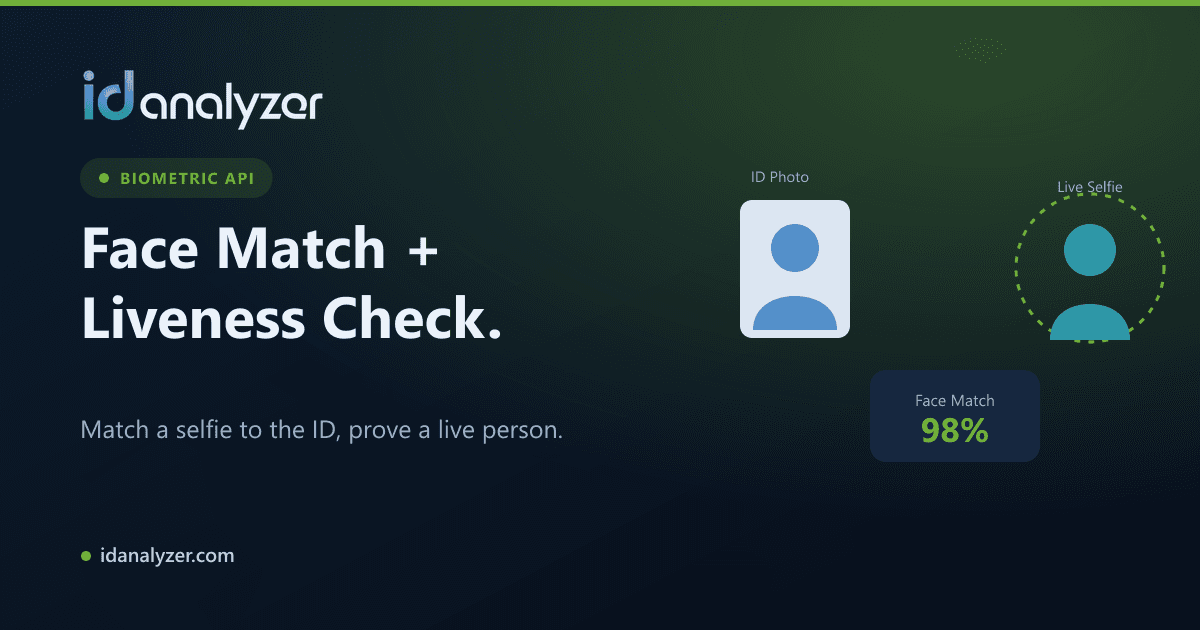
Once the document is confirmed authentic, compare the live face against the document portrait. Because the document has already passed authentication, a match now means something: the person in front of the camera is the person the credential was issued to.
3. Liveness detection
Face match alone can be spoofed with a photo, a screen replay or a deepfake feed. Liveness detection is the control aimed squarely at synthetic and presentation attacks — it checks that a real, present human is being captured, not a still image, a looping video or an injected stream.
Pairing liveness with face match is what makes deepfakes hard: the attacker must produce a face that both matches the authenticated document and survives liveness checks in real time.
4. Screening on the confirmed identity
Once you know the identity is real and correctly bound to a live person, run AML, PEP and criminal-records screening. Screening the wrong (fraudulent) identity is worse than useless — it produces false confidence. Do it after the identity is verified, not before.
Practical guidance for your team
A few things worth building into your process regardless of provider:
- Order your checks. Authenticate the document first, then bind a face to it, then screen. Each stage should feed the next.
- Log the signals, not just the verdict. When a case is disputed or reviewed, you want the individual authentication, match and liveness results, not a single pass/fail.
- Set thresholds per risk level. A low-risk sign-up and a high-value transfer should not share the same liveness and match strictness.
- Keep data controls tight. Biometric and document data are sensitive; use encrypted storage and, where regulations demand it, deployment options that keep data in your environment.
For teams with strict data-residency or on-premise requirements, ID Fort runs the same verification stack inside your own infrastructure, while Vault provides encrypted storage for the artifacts you do retain. ID Analyzer operates an ISO 27001-certified environment across these products.
The takeaway
Deepfakes, photo substitution and forgery are not one problem — they are three, each aimed at a different link in the chain. You beat them not with a smarter single check, but with independent layers: authenticate the document, match the face, confirm liveness, then screen. Break any one link and the fraud collapses.