

Deepfakes, Photo Substitution and Document Fraud: What KYC Teams Need to Know
Identity fraud is no longer limited to a forged passport slid across a counter. Today's attacks are digital, scalable, and increasingly automated. Deepfakes and photo substitution sit at the center of that shift, and they target the two things every KYC flow depends on: the document and the face.
This post breaks down how these attacks work, where they hit your verification pipeline, and which layered controls actually stop them.
Three attacks that look similar but aren't
It helps to separate the threats, because the defenses differ.
Deepfakes
A deepfake is synthetic or manipulated media — usually a face — generated or swapped using machine learning. In a KYC context, an attacker uses a deepfake to defeat the biometric step: they present a fabricated face during a selfie check or inject a synthetic video into the camera feed.
The goal is to pass face matching and liveness while the real person is never present.
Photo substitution
Photo substitution is older and more direct. An attacker takes a genuine document template and replaces the portrait with a different face — often their own. The document data may be real, stolen, or fabricated, but the photo is swapped so the face match "succeeds" against the wrong person.
This is a document-integrity problem first and a biometric problem second.
Document fraud more broadly
Beyond photo swaps, document fraud includes fully forged documents, altered text fields (name, date of birth, expiry), tampered MRZ or barcode data, and recaptured images (a photo of a screen showing a document). Each of these leaves traces if you know where to look.
Where these attacks hit your pipeline
A typical verification flow has a few checkpoints, and each one is a potential target:
- Document capture — forged, altered, or recaptured documents.
- Data extraction — mismatches between printed text, the MRZ, and the barcode.
- Document authentication — missing or inconsistent security features.
- Biometric match — photo substitution breaks the link between document and holder.
- Liveness — deepfakes and presentation attacks target this stage.
A single-layer check is easy to defeat. The attacker only has to beat one gate. A layered approach forces them to beat all of them simultaneously, which is far harder.
Defending against photo substitution
Photo substitution is best caught at the document layer, before you ever trust the portrait.
Start with document authentication. Genuine IDs carry security features and consistent layouts. When a portrait is physically or digitally swapped, it often disrupts fonts, spacing, background patterns, or the relationship between the photo and surrounding elements.
Next, cross-check the data sources on the document. Reading the MRZ on passports and the barcode on many ID cards lets you compare those encoded fields against the printed text. A substituted photo paired with tampered fields frequently produces a mismatch that OCR-plus-MRZ comparison exposes.
Tip
Always compare the visual zone (printed text), the MRZ, and the barcode against each other. Fraudsters who edit one layer often forget the others, and the inconsistency is your signal.
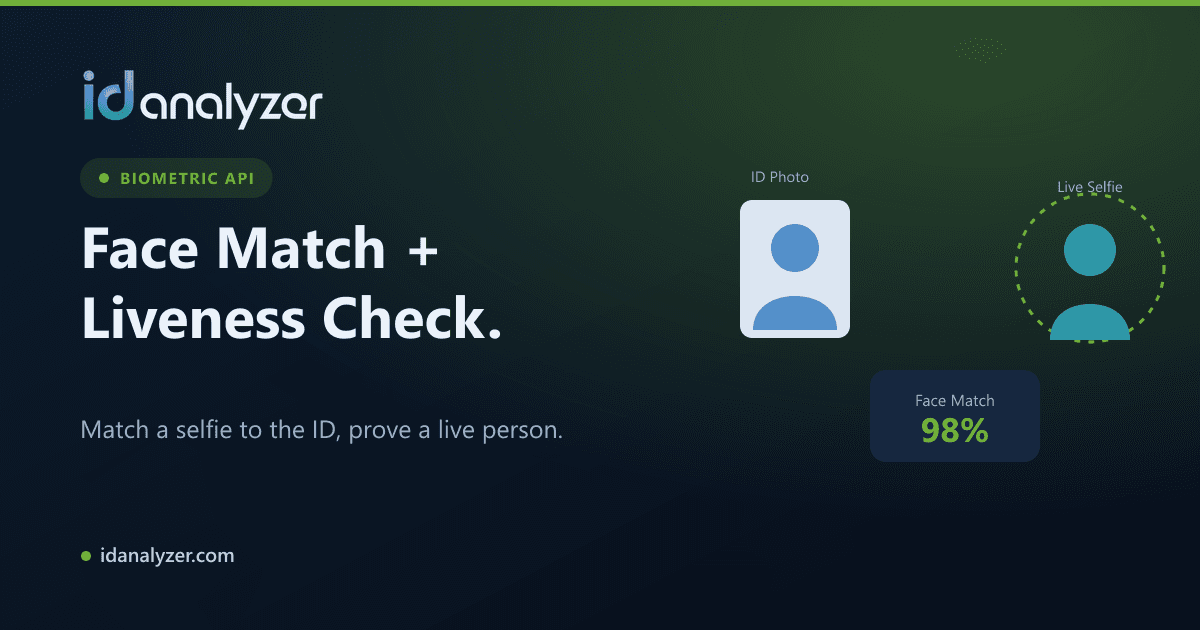
Finally, run a biometric face match between the document portrait and a freshly captured selfie. If the document photo was swapped to the attacker's own face, authentication and data cross-checks are what catch it — not the face match, which will happily confirm a fraudulent pairing.
Defending against deepfakes
Deepfakes attack the live-person step, so your defense lives in the biometric and liveness layers.
Liveness detection is the primary control. The goal is to confirm that a real, present human is in front of the camera — not a photo, a replayed video, a mask, or a synthetic rendering. Combined with face matching, liveness anchors the session to a genuine human and ties them to the verified document.
Treat the selfie as a live event, not a static upload. Static image comparison alone cannot distinguish a real face from a well-rendered fake. The combination of face match and liveness is what raises the cost for attackers.
Why layering beats any single check
No single signal is sufficient on its own:
- A clean document photo means nothing if the portrait was substituted.
- A perfect face match means nothing if the matched face is a deepfake.
- A passing liveness check means nothing if the underlying document is forged.
The strength comes from correlation. Authenticate the document, cross-validate its data sources, match the holder's face, and confirm liveness. When all four agree, you have a defensible decision. When one disagrees, you have a flag worth reviewing.
Building this into your stack
You don't need to assemble these controls from scratch. ID Analyzer supports document OCR, MRZ and barcode reading, document authentication and anti-forgery checks across 3,000+ document formats from 190+ countries, plus biometric face match and liveness — the exact layers these attacks try to slip through.
For teams with data-residency or regulatory constraints, the same capabilities are available on-premise through ID Fort, so sensitive images never leave your environment. ID Analyzer is ISO 27001 certified.
A short checklist
Before you ship a verification flow, confirm you have:
- Document authentication and anti-forgery checks, not just OCR.
- Cross-validation between printed text, MRZ, and barcode.
- Biometric face match linking document portrait to the live user.
- Liveness detection to defeat deepfakes and presentation attacks.
- A review path for mismatched or low-confidence results.
Deepfakes and photo substitution are getting cheaper and more convincing. The answer isn't a single silver-bullet model — it's overlapping checks that each close a different door, so an attacker has to beat all of them at once.